Genome sequences of 11 avian influenza virus (AIV) subtypes have been reported in swine populations from seven nations till August 2020. To unravel the transmission dynamics and spillover occasions of AIVs from avian reservoirs to swine, full-length hemagglutinin (HA) sequences of AIV subtypes (n = 11) reported from numerous avian species and swine have been retrieved from the ‘Influenza Analysis Database’. Phylogenetic evaluation recognized intently associated avian and swine AIV sequences suggesting potential spillover occasions from a number of home and wild avian species, together with hen, duck, pigeon, goose, quail, and aquatic birds to swine.
Moreover, N-linked glycosylation evaluation of those intently associated AIV sequences supported the opportunity of a number of spillover occasions of extremely pathogenic H5N1 and low pathogenic H9N2 viruses from numerous avian species to swine. The principal coordinate evaluation additional validated these findings for H5N1 and H9N2 viruses; nonetheless, spillover occasions of the opposite 9 AIV subtypes have been restricted.
Apparently, the presence of potential mammalian adaptation markers, significantly in among the swine H5N1, H7N9, and H9N2 viruses, steered that these viruses might have already tailored in swine. The incidence and circulation of those AIVs in swine, particularly the H5N1 and H9N2 viruses with quite a few spillover occasions from the avian reservoirs to swine, pose a big risk when it comes to their reassortment with endemic swine viruses or circulating human influenza viruses throughout the swine which can facilitate the emergence of a novel influenza virus pressure with pandemic potential.
Vaccination with inactivated virus towards low pathogenic avian influenza subtype H9N2 doesn’t stop virus transmission in chickens
H9N2 subtype avian influenza has unfold dramatically in China ever since first reported within the 1990s. A nationwide vaccination program for poultry was initiated in 1998. Area isolation knowledge present that the extensively used inactivated H9N2 vaccine doesn’t present efficient management of the transmission of this low pathogenic avian influenza (LPAI) virus in poultry. Present analysis has centered on two causes: (i) inadequate immune response triggered by the vaccination with the inactivated virus, (ii) the incidence of escape mutants chosen by vaccine-induced immune stress.
Nevertheless, the dearth of effectivity of the inactivated virus vaccine to sufficiently scale back transmission has been seen. We mimicked the pure an infection and transmission means of the H9N2 virus in vaccinated and non-vaccinated chickens. A statistical mannequin was used to estimate the transmission fee parameters amongst vaccinated chickens, various in serum hemagglutinin inhibition titers (HIT) and non-vaccinated chickens.
We reveal, for the primary time, that the transmission shouldn’t be sufficiently decreased by the H9N2 vaccine, even when vaccinated chickens have an IgG serum titer (HIT>23), which is taken into account protecting for vaccination towards homologous extremely pathogenic avian influenza (HPAI) virus. Our research does, however, solid new mild on virus transmission and immune escape of LPAI H9N2 virus in vaccinated chickens populations, and exhibits that new mitigation methods towards LPAI viruses in poultry are wanted.
Growth of PDA Nanoparticles for H9N2 Avian Influenza BPP-V/BP-IV Epitope Peptide Vaccines: Immunogenicity and Supply Effectivity Enchancment
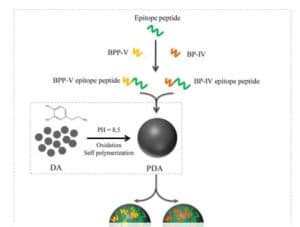
The safety of present influenza vaccines is proscribed as a result of viral antigenic shifts and antigenic drifts. The common influenza vaccine is a brand new hotspot in vaccine analysis that goals to beat these issues. Polydopamine (PDA), a flexible biomaterial, has some great benefits of a superb biocompatibility, controllable particle measurement, and distinctive drug loading strategy in drug supply methods.
To boost the immunogenicities and supply efficiencies of H9N2 avian influenza virus (AIV) epitope peptide vaccines, PDA nanoparticles conjugated with the BPP-V and BP-IV epitope peptides have been used to arrange the nano BPP-V and BP-IV epitope peptide vaccines, respectively. The traits of the newly developed epitope peptide vaccines have been then evaluated, revealing particle sizes starting from roughly 240 to 290 nm (PDI<0.3), indicating that the synthesized nanoparticles have been secure. Concurrently, the immunoprotective results of nano BPP-V and BP-IV epitope peptide vaccines have been assessed.
The nano BPP-V and BP-IV epitope vaccines, particularly nano BP-IV epitope vaccine, shortly induced anti-hemagglutinin (HA) antibody manufacturing and a sustained immune response, considerably promoted humoral and mobile immune responses, decreased viral lung harm and offered efficient safety towards AIV viral an infection. Collectively, these outcomes reveal that PDA, as a supply provider, can enhance the immunogenicities and supply efficiencies of H9N2 AIV nano epitope vaccines, thereby offering a theoretical foundation for the design and growth of PDA as a provider of latest common influenza vaccines.
A mixed-methods research of stakeholders’ practices and attitudes on avian influenza H7N9 vaccination for the yellow broiler business in Guangxi, China
In response to a sudden enhance in H7N9 human infections, China launched a H5/H7 bivalent inactivated vaccine for poultry in Guangxi and Guangdong provinces in July 2017, which subsequently grew to become built-in into the prevailing obligatory nationwide H5N1 vaccination program from September 2017. Though the vaccination program successfully decreased H7N9 infections in people and poultry, there are ongoing arguments towards persevering with this long-term vaccination.
These discussions have drawn policymakers to consider the opportunity of stopping routine vaccination for H7N9 avian influenza viruses (AIVs) in China, nonetheless they haven’t thought-about the poultry business stakeholders’ practices on and attitudes in the direction of this vaccination. This research investigated H7N9 vaccination practices within the yellow broiler business in Guangxi and stakeholders’ attitudes on H7N9 vaccination, utilizing a mixed-methods design. The research discovered H7N9 vaccination was effectively adopted within the yellow broiler business in Guangxi whatever the supply of the vaccines.
Most stakeholders believed vaccination was one of the best measure to manage H7N9 and H5N1 AIVs, they usually confirmed a robust willingness to proceed with vaccination even with out authorities subsidies or freely offered vaccines. The motivations by stakeholders for utilizing vaccines to manage H7N9 and H5N1 have been totally different as a result of epidemiological variations between the 2 strains. Understanding poultry business stakeholders’ practices and attitudes on H7N9 vaccination has vital sensible implications in planning vaccination insurance policies, significantly when contemplating the opportunity of vaccination withdrawal. This text is protected by copyright. All rights reserved.
Information, Attitudes, and Danger Notion Towards Avian Influenza Virus Publicity Amongst Cuban Hunters
A essential step for reducing zoonotic illness threats is to have an excellent understanding of the related dangers. Hunters incessantly deal with doubtlessly contaminated birds, so they’re extra prone to being uncovered to zoonotic avian pathogens, together with avian influenza viruses (AIVs). The target of the present research was to realize a greater understanding of Cuban hunters’ common looking practices, specializing in their data and danger notion on avian influenza.
An nameless and voluntary semi-structured questionnaire was designed and utilized to 398 hunters. A number of correspondence analyses discovered relationships with potential publicity of AIVs to folks and home animals. The primary related dangers components recognized weren’t taking the annual flu vaccine (60.1%) and never cleansing looking knives (26.3%); Direct contact with water (32.1%), cleansing wild birds at dwelling (33.2%); receiving help throughout hen cleansing (41.9%), protecting poultry at dwelling (56.5%) and feeding home animals with wild hen leftovers (30.3%) have been additionally recognized as important danger components.
 Avian Influenza A M2 Antibody |
|
MBS9405612-5x01mL |
MyBiosource |
5x0.1mL |
EUR 2075 |
 Polyclonal Avian Influenza A H7N9 Hemagglutinin Antibody |
|
APR10994G |
Leading Biology |
0.1 mg |
EUR 790.8 |
|
Description: A polyclonal antibody raised in Rabbit that recognizes and binds to Human Avian Influenza A H7N9 Hemagglutinin . This antibody is tested and proven to work in the following applications: |
Polyclonal Avian Influenza A H7N9 Hemagglutinin Antibody |
|
APR10995G |
Leading Biology |
0.1 mg |
EUR 790.8 |
|
Description: A polyclonal antibody raised in Rabbit that recognizes and binds to Human Avian Influenza A H7N9 Hemagglutinin . This antibody is tested and proven to work in the following applications: |
Polyclonal Avian Influenza A H7N9 Hemagglutinin Antibody |
|
APR10996G |
Leading Biology |
0.1 mg |
EUR 790.8 |
|
Description: A polyclonal antibody raised in Rabbit that recognizes and binds to Human Avian Influenza A H7N9 Hemagglutinin . This antibody is tested and proven to work in the following applications: |
 Polyclonal Avian Influenza A H7N9 Neuraminidase Antibody |
|
APR10997G |
Leading Biology |
0.1 mg |
EUR 790.8 |
|
Description: A polyclonal antibody raised in Rabbit that recognizes and binds to Human Avian Influenza A H7N9 Neuraminidase . This antibody is tested and proven to work in the following applications: |
Polyclonal Avian Influenza A H7N9 Neuraminidase Antibody |
|
APR10998G |
Leading Biology |
0.1 mg |
EUR 790.8 |
|
Description: A polyclonal antibody raised in Rabbit that recognizes and binds to Human Avian Influenza A H7N9 Neuraminidase . This antibody is tested and proven to work in the following applications: |
Polyclonal Avian Influenza A H7N9 Neuraminidase Antibody |
|
APR10999G |
Leading Biology |
0.1 mg |
EUR 790.8 |
|
Description: A polyclonal antibody raised in Rabbit that recognizes and binds to Human Avian Influenza A H7N9 Neuraminidase . This antibody is tested and proven to work in the following applications: |
 Polyclonal Avian Influenza Neuraminidase Antibody |
|
APR11000G |
Leading Biology |
0.1 mg |
EUR 790.8 |
|
Description: A polyclonal antibody raised in Rabbit that recognizes and binds to Human Avian Influenza Neuraminidase . This antibody is tested and proven to work in the following applications: |
Polyclonal Avian Influenza Neuraminidase Antibody |
|
APR11001G |
Leading Biology |
0.1 mg |
EUR 790.8 |
|
Description: A polyclonal antibody raised in Rabbit that recognizes and binds to Human Avian Influenza Neuraminidase . This antibody is tested and proven to work in the following applications: |
 Antibody) Avian Influenza Virus M2 (H5N1 M2) Antibody |
|
abx012387-100g |
Abbexa |
100 µg |
Ask for price |
Avian Influenza Virus M2 (H5N1 M2) Antibody |
|
abx012387-10g |
Abbexa |
10 µg |
EUR 662.5 |
Avian Influenza Virus M2 (H5N1 M2) Antibody |
|
abx012387-200g |
Abbexa |
200 µg |
Ask for price |
 Avian Influenza A M2 Peptide |
|
4333P |
ProSci |
0.05 mg |
EUR 197.7 |
|
Description: (NT) Avian Influenza A M2 peptide |
Avian Influenza A M2 Peptide |
|
MBS153247-005mg |
MyBiosource |
0.05mg |
EUR 175 |
Avian Influenza A M2 Peptide |
|
MBS153247-5x005mg |
MyBiosource |
5x0.05mg |
EUR 770 |
 Hemagglutinin/HA Antibody, Rabbit MAb) Influenza A H5N1 (Avian Flu) Hemagglutinin/HA Antibody, Rabbit MAb |
|
MBS8104692-002mL |
MyBiosource |
0.02mL |
EUR 185 |
Influenza A H5N1 (Avian Flu) Hemagglutinin/HA Antibody, Rabbit MAb |
|
MBS8104692-01mL |
MyBiosource |
0.1mL |
EUR 385 |
Influenza A H5N1 (Avian Flu) Hemagglutinin/HA Antibody, Rabbit MAb |
|
MBS8104692-5x01mL |
MyBiosource |
5x0.1mL |
EUR 1590 |
Influenza A H5N1 (Avian Flu) Hemagglutinin/HA Antibody, Rabbit MAb |
|
MBS8104693-002mL |
MyBiosource |
0.02mL |
EUR 185 |
Influenza A H5N1 (Avian Flu) Hemagglutinin/HA Antibody, Rabbit MAb |
|
MBS8104693-01mL |
MyBiosource |
0.1mL |
EUR 385 |
Influenza A H5N1 (Avian Flu) Hemagglutinin/HA Antibody, Rabbit MAb |
|
MBS8104693-5x01mL |
MyBiosource |
5x0.1mL |
EUR 1590 |
Influenza A H5N1 (Avian Flu) Hemagglutinin/HA Antibody, Rabbit MAb |
|
MBS8104694-002mL |
MyBiosource |
0.02mL |
EUR 185 |
Influenza A H5N1 (Avian Flu) Hemagglutinin/HA Antibody, Rabbit MAb |
|
MBS8104694-01mL |
MyBiosource |
0.1mL |
EUR 385 |
Influenza A H5N1 (Avian Flu) Hemagglutinin/HA Antibody, Rabbit MAb |
|
MBS8104694-5x01mL |
MyBiosource |
5x0.1mL |
EUR 1590 |
 Hemagglutinin/HA Antibody, Rabbit PAb) Influenza A H5N1 (Avian Flu) Hemagglutinin/HA Antibody, Rabbit PAb |
|
MBS8104695-002mL |
MyBiosource |
0.02mL |
EUR 175 |
Influenza A H5N1 (Avian Flu) Hemagglutinin/HA Antibody, Rabbit PAb |
|
MBS8104695-01mL |
MyBiosource |
0.1mL |
EUR 320 |
Influenza A H5N1 (Avian Flu) Hemagglutinin/HA Antibody, Rabbit PAb |
|
MBS8104695-5x01mL |
MyBiosource |
5x0.1mL |
EUR 1300 |
 Avian Influenza A Hemagglutinin Antibody |
|
GWB-68DB90 |
GenWay Biotech |
0.1 mg |
Ask for price |
 Influenza A H5N1 Avian Antibody |
|
abx023061-100ug |
Abbexa |
100 ug |
EUR 961.2 |
|
|
Influenza A H5N1 Avian Antibody |
|
abx023062-100ug |
Abbexa |
100 ug |
EUR 828 |
|
|
Influenza A H5N1 Avian Antibody |
|
abx023064-100ug |
Abbexa |
100 ug |
EUR 961.2 |
|
|
Influenza A H5N1 Avian Antibody |
|
abx021960-100ug |
Abbexa |
100 ug |
EUR 1011.6 |
|
|
Influenza A H5N1 Avian Antibody |
|
abx021960-400l |
Abbexa |
400 µl |
Ask for price |
Influenza A H5N1 Avian Antibody |
|
abx021960-80l |
Abbexa |
80 µl |
EUR 1062.5 |
Influenza A H5N1 Avian Antibody |
|
abx021961-100ug |
Abbexa |
100 ug |
EUR 1011.6 |
|
|
Influenza A H5N1 Avian Antibody |
|
abx021961-400l |
Abbexa |
400 µl |
Ask for price |
Influenza A H5N1 Avian Antibody |
|
abx021961-80l |
Abbexa |
80 µl |
EUR 1062.5 |
 Hemagglutinin/HA Antibody (Biotin), Rabbit PAb) Influenza A H5N1 (Avian Flu) Hemagglutinin/HA Antibody (Biotin), Rabbit PAb |
|
MBS8104696-01mg |
MyBiosource |
0.1mg |
EUR 390 |
Influenza A H5N1 (Avian Flu) Hemagglutinin/HA Antibody (Biotin), Rabbit PAb |
|
MBS8104696-5x01mg |
MyBiosource |
5x0.1mg |
EUR 1595 |
 Avian Influenza A H7N9 Hemagglutinin Antibody |
|
7821-002mg |
ProSci |
0.02 mg |
EUR 206.18 |
|
|
|
Description: Influenza A virus is a major public health threat, killing more than 30,000 people per year in the USA (1). Novel influenza virus strains caused by genetic drift and viral recombination emerge periodically to which humans have little or no immunity, resulting in devastating pandemics. Influenza A can exist in a variety of animals; however it is in birds that all subtypes can be found (2). These subtypes are classified based on the combination of the virus coat glycoproteins hemagglutinin (HA) and neuraminidase (NA) subtypes. H7N9 bird flu is the newest atypical influenza virus infection that has just been reported since early 2013. The emergence of this new strain occurred in China and has become the present focus for possible worldwide pandemic (3). |
Avian Influenza A H7N9 Hemagglutinin Antibody |
|
7821-01mg |
ProSci |
0.1 mg |
EUR 523.7 |
|
|
|
Description: Influenza A virus is a major public health threat, killing more than 30,000 people per year in the USA (1). Novel influenza virus strains caused by genetic drift and viral recombination emerge periodically to which humans have little or no immunity, resulting in devastating pandemics. Influenza A can exist in a variety of animals; however it is in birds that all subtypes can be found (2). These subtypes are classified based on the combination of the virus coat glycoproteins hemagglutinin (HA) and neuraminidase (NA) subtypes. H7N9 bird flu is the newest atypical influenza virus infection that has just been reported since early 2013. The emergence of this new strain occurred in China and has become the present focus for possible worldwide pandemic (3). |
Avian Influenza A H7N9 Hemagglutinin Antibody |
|
7823-002mg |
ProSci |
0.02 mg |
EUR 206.18 |
|
|
|
Description: Influenza A virus is a major public health threat, killing more than 30,000 people per year in the USA (1). Novel influenza virus strains caused by genetic drift and viral recombination emerge periodically to which humans have little or no immunity, resulting in devastating pandemics. Influenza A can exist in a variety of animals; however it is in birds that all subtypes can be found (2). These subtypes are classified based on the combination of the virus coat glycoproteins hemagglutinin (HA) and neuraminidase (NA) subtypes. H7N9 bird flu is the newest atypical influenza virus infection that has just been reported since early 2013. The emergence of this new strain occurred in China and has become the present focus for possible worldwide pandemic (3). |
Avian Influenza A H7N9 Hemagglutinin Antibody |
|
7823-01mg |
ProSci |
0.1 mg |
EUR 523.7 |
|
|
|
Description: Influenza A virus is a major public health threat, killing more than 30,000 people per year in the USA (1). Novel influenza virus strains caused by genetic drift and viral recombination emerge periodically to which humans have little or no immunity, resulting in devastating pandemics. Influenza A can exist in a variety of animals; however it is in birds that all subtypes can be found (2). These subtypes are classified based on the combination of the virus coat glycoproteins hemagglutinin (HA) and neuraminidase (NA) subtypes. H7N9 bird flu is the newest atypical influenza virus infection that has just been reported since early 2013. The emergence of this new strain occurred in China and has become the present focus for possible worldwide pandemic (3). |
Avian Influenza A H7N9 Hemagglutinin Antibody |
|
7825-002mg |
ProSci |
0.02 mg |
EUR 206.18 |
|
|
|
Description: Influenza A virus is a major public health threat, killing more than 30,000 people per year in the USA (1). Novel influenza virus strains caused by genetic drift and viral recombination emerge periodically to which humans have little or no immunity, resulting in devastating pandemics. Influenza A can exist in a variety of animals; however it is in birds that all subtypes can be found (2). These subtypes are classified based on the combination of the virus coat glycoproteins hemagglutinin (HA) and neuraminidase (NA) subtypes. H7N9 bird flu is the newest atypical influenza virus infection that has just been reported since early 2013. The emergence of this new strain occurred in China and has become the present focus for possible worldwide pandemic (3). |
Avian Influenza A H7N9 Hemagglutinin Antibody |
|
7825-01mg |
ProSci |
0.1 mg |
EUR 523.7 |
|
|
|
Description: Influenza A virus is a major public health threat, killing more than 30,000 people per year in the USA (1). Novel influenza virus strains caused by genetic drift and viral recombination emerge periodically to which humans have little or no immunity, resulting in devastating pandemics. Influenza A can exist in a variety of animals; however it is in birds that all subtypes can be found (2). These subtypes are classified based on the combination of the virus coat glycoproteins hemagglutinin (HA) and neuraminidase (NA) subtypes. H7N9 bird flu is the newest atypical influenza virus infection that has just been reported since early 2013. The emergence of this new strain occurred in China and has become the present focus for possible worldwide pandemic (3). |
 Avian Influenza A H7N9 Neuraminidase Antibody |
|
7827-002mg |
ProSci |
0.02 mg |
EUR 206.18 |
|
|
|
Description: Influenza A virus is a major public health threat, killing more than 30,000 people per year in the USA (1). Novel influenza virus strains caused by genetic drift and viral recombination emerge periodically to which humans have little or no immunity, resulting in devastating pandemics. Influenza A can exist in a variety of animals; however it is in birds that all subtypes can be found (2). These subtypes are classified based on the combination of the virus coat glycoproteins hemagglutinin (HA) and neuraminidase (NA) subtypes. H7N9 bird flu is the newest atypical influenza virus infection that has just been reported since early 2013. The emergence of this new strain occurred in China and has become the present focus for possible worldwide pandemic (3). |
Avian Influenza A H7N9 Neuraminidase Antibody |
|
7827-01mg |
ProSci |
0.1 mg |
EUR 523.7 |
|
|
|
Description: Influenza A virus is a major public health threat, killing more than 30,000 people per year in the USA (1). Novel influenza virus strains caused by genetic drift and viral recombination emerge periodically to which humans have little or no immunity, resulting in devastating pandemics. Influenza A can exist in a variety of animals; however it is in birds that all subtypes can be found (2). These subtypes are classified based on the combination of the virus coat glycoproteins hemagglutinin (HA) and neuraminidase (NA) subtypes. H7N9 bird flu is the newest atypical influenza virus infection that has just been reported since early 2013. The emergence of this new strain occurred in China and has become the present focus for possible worldwide pandemic (3). |
Avian Influenza A H7N9 Neuraminidase Antibody |
|
7831-002mg |
ProSci |
0.02 mg |
EUR 206.18 |
|
|
|
Description: Influenza A virus is a major public health threat, killing more than 30,000 people per year in the USA (1). Novel influenza virus strains caused by genetic drift and viral recombination emerge periodically to which humans have little or no immunity, resulting in devastating pandemics. Influenza A can exist in a variety of animals; however it is in birds that all subtypes can be found (2). These subtypes are classified based on the combination of the virus coat glycoproteins hemagglutinin (HA) and neuraminidase (NA) subtypes. H7N9 bird flu is the newest atypical influenza virus infection that has just been reported since early 2013. The emergence of this new strain occurred in China and has become the present focus for possible worldwide pandemic (3). |
Avian Influenza A H7N9 Neuraminidase Antibody |
|
7831-01mg |
ProSci |
0.1 mg |
EUR 523.7 |
|
|
|
Description: Influenza A virus is a major public health threat, killing more than 30,000 people per year in the USA (1). Novel influenza virus strains caused by genetic drift and viral recombination emerge periodically to which humans have little or no immunity, resulting in devastating pandemics. Influenza A can exist in a variety of animals; however it is in birds that all subtypes can be found (2). These subtypes are classified based on the combination of the virus coat glycoproteins hemagglutinin (HA) and neuraminidase (NA) subtypes. H7N9 bird flu is the newest atypical influenza virus infection that has just been reported since early 2013. The emergence of this new strain occurred in China and has become the present focus for possible worldwide pandemic (3). |
Avian Influenza A H7N9 Neuraminidase Antibody |
|
7833-002mg |
ProSci |
0.02 mg |
EUR 206.18 |
|
|
|
Description: Influenza A virus is a major public health threat, killing more than 30,000 people per year in the USA (1). Novel influenza virus strains caused by genetic drift and viral recombination emerge periodically to which humans have little or no immunity, resulting in devastating pandemics. Influenza A can exist in a variety of animals; however it is in birds that all subtypes can be found (2). These subtypes are classified based on the combination of the virus coat glycoproteins hemagglutinin (HA) and neuraminidase (NA) subtypes. H7N9 bird flu is the newest atypical influenza virus infection that has just been reported since early 2013. The emergence of this new strain occurred in China and has become the present focus for possible worldwide pandemic (3). |
Avian Influenza A H7N9 Neuraminidase Antibody |
|
7833-01mg |
ProSci |
0.1 mg |
EUR 523.7 |
|
|
|
Description: Influenza A virus is a major public health threat, killing more than 30,000 people per year in the USA (1). Novel influenza virus strains caused by genetic drift and viral recombination emerge periodically to which humans have little or no immunity, resulting in devastating pandemics. Influenza A can exist in a variety of animals; however it is in birds that all subtypes can be found (2). These subtypes are classified based on the combination of the virus coat glycoproteins hemagglutinin (HA) and neuraminidase (NA) subtypes. H7N9 bird flu is the newest atypical influenza virus infection that has just been reported since early 2013. The emergence of this new strain occurred in China and has become the present focus for possible worldwide pandemic (3). |
Avian Influenza A H7N9 Hemagglutinin Antibody |
|
MBS153473-01mg |
MyBiosource |
0.1mg |
EUR 445 |
Avian Influenza A H7N9 Hemagglutinin Antibody |
|
MBS153473-5x01mg |
MyBiosource |
5x0.1mg |
EUR 1965 |
Avian Influenza A H7N9 Neuraminidase Antibody |
|
MBS153517-01mg |
MyBiosource |
0.1mg |
EUR 445 |
Avian Influenza A H7N9 Neuraminidase Antibody |
|
MBS153517-5x01mg |
MyBiosource |
5x0.1mg |
EUR 1965 |
Avian Influenza A H7N9 Hemagglutinin Antibody |
|
MBS153575-01mg |
MyBiosource |
0.1mg |
EUR 445 |
Avian Influenza A H7N9 Hemagglutinin Antibody |
|
MBS153575-5x01mg |
MyBiosource |
5x0.1mg |
EUR 1965 |
Avian Influenza A H7N9 Neuraminidase Antibody |
|
MBS153618-01mg |
MyBiosource |
0.1mg |
EUR 445 |
Avian Influenza A H7N9 Neuraminidase Antibody |
|
MBS153618-5x01mg |
MyBiosource |
5x0.1mg |
EUR 1965 |
Avian Influenza A H7N9 Neuraminidase Antibody |
|
MBS153679-01mg |
MyBiosource |
0.1mg |
EUR 445 |
Avian Influenza A H7N9 Neuraminidase Antibody |
|
MBS153679-5x01mg |
MyBiosource |
5x0.1mg |
EUR 1965 |
Avian Influenza A H7N9 Hemagglutinin Antibody |
|
MBS153697-01mg |
MyBiosource |
0.1mg |
EUR 445 |
Avian Influenza A H7N9 Hemagglutinin Antibody |
|
MBS153697-5x01mg |
MyBiosource |
5x0.1mg |
EUR 1965 |
 rabbit polyclonal antibody) Influenza A H1N1 (A/California/14/2009) rabbit polyclonal antibody |
|
RA19071-100 |
Origene Technologies GmbH |
100 µl |
Ask for price |
 Polyclonal Antibody) Rabbit anti H2N2 (Influenza A virus) Polyclonal Antibody |
|
MBS460369-01mg |
MyBiosource |
0.1mg |
EUR 305 |
Rabbit anti H2N2 (Influenza A virus) Polyclonal Antibody |
|
MBS460369-5x01mg |
MyBiosource |
5x0.1mg |
EUR 1325 |
 Avian Influenza A H5N1 |
|
Oneq-H441-OneqH441100R |
Bioingentech |
Oneq-H441-100R |
EUR 1028 |
Avian Influenza A H5N1 |
|
Oneq-H441-OneqH441150R |
Bioingentech |
Oneq-H441-150R |
EUR 1438 |
Avian Influenza A H5N1 |
|
Oneq-H441-OneqH44150R |
Bioingentech |
Oneq-H441-50R |
EUR 728 |
Avian Influenza A H5N1 |
|
PCR-H441-PCRH44148R |
Bioingentech |
PCR-H441-48R |
EUR 485 |
Avian Influenza A H5N1 |
|
PCR-H441-PCRH44196R |
Bioingentech |
PCR-H441-96R |
EUR 685 |
 Avian Influenza Neuraminidase Antibody |
|
3421-002mg |
ProSci |
0.02 mg |
EUR 206.18 |
|
|
|
Description: Avian Influenza Neuraminidase Antibody: Influenza A virus is a major public health threat, killing more than 30, 000 people per year in the USA. Novel influenza virus strains emerge periodically to which humans have little or no immunity, resulting in devastating pandemics. Influenza A can exist in a variety of animals; however it is in birds that all subtypes can be found. These subtypes are classified based on the combination of the virus coat glycoproteins hemagglutinin (HA) and neuraminidase (NA) subtypes. During 1997, an H5N1 avian influenza virus was determined to be the cause of death in 6 of 18 infected patients in Hong Kong. There was some evidence of human to human spread of this virus, but it is thought that the transmission efficiency was fairly low. Although it has been known that cleavage site and glycosylation patterns of the HA protein play important roles in determining the pathogenicity of H5 avian influenza viruses, it has only recently been shown that an additional glycosylation site within the globular head of the NA protein also contributes to the high virulence of the H5N1 virus. |
Avian Influenza Neuraminidase Antibody |
|
3421-01mg |
ProSci |
0.1 mg |
EUR 523.7 |
|
|
|
Description: Avian Influenza Neuraminidase Antibody: Influenza A virus is a major public health threat, killing more than 30, 000 people per year in the USA. Novel influenza virus strains emerge periodically to which humans have little or no immunity, resulting in devastating pandemics. Influenza A can exist in a variety of animals; however it is in birds that all subtypes can be found. These subtypes are classified based on the combination of the virus coat glycoproteins hemagglutinin (HA) and neuraminidase (NA) subtypes. During 1997, an H5N1 avian influenza virus was determined to be the cause of death in 6 of 18 infected patients in Hong Kong. There was some evidence of human to human spread of this virus, but it is thought that the transmission efficiency was fairly low. Although it has been known that cleavage site and glycosylation patterns of the HA protein play important roles in determining the pathogenicity of H5 avian influenza viruses, it has only recently been shown that an additional glycosylation site within the globular head of the NA protein also contributes to the high virulence of the H5N1 virus. |
Avian Influenza Neuraminidase Antibody |
|
3423-002mg |
ProSci |
0.02 mg |
EUR 206.18 |
|
|
|
Description: Avian Influenza Neuraminidase Antibody: Influenza A virus is a major public health threat, killing more than 30,000 people per year in the USA. Novel influenza virus strains emerge periodically to which humans have little or no immunity, resulting in devastating pandemics. Influenza A can exist in a variety of animals; however it is in birds that all subtypes can be found. These subtypes are classified based on the combination of the virus coat glycoproteins hemagglutinin (HA) and neuraminidase (NA) subtypes. During 1997, an H5N1 avian influenza virus was determined to be the cause of death in 6 of 18 infected patients in Hong Kong. There was some evidence of human to human spread of this virus, but it is thought that the transmission efficiency was fairly low. Although it has been known that cleavage site and glycosylation patterns of the HA protein play important roles in determining the pathogenicity of H5 avian influenza viruses, it has only recently been shown that an additional glycosylation site within the globular head of the NA protein also contributes to the high virulence of the H5N1 virus. |
Avian Influenza Neuraminidase Antibody |
|
3423-01mg |
ProSci |
0.1 mg |
EUR 523.7 |
|
|
|
Description: Avian Influenza Neuraminidase Antibody: Influenza A virus is a major public health threat, killing more than 30,000 people per year in the USA. Novel influenza virus strains emerge periodically to which humans have little or no immunity, resulting in devastating pandemics. Influenza A can exist in a variety of animals; however it is in birds that all subtypes can be found. These subtypes are classified based on the combination of the virus coat glycoproteins hemagglutinin (HA) and neuraminidase (NA) subtypes. During 1997, an H5N1 avian influenza virus was determined to be the cause of death in 6 of 18 infected patients in Hong Kong. There was some evidence of human to human spread of this virus, but it is thought that the transmission efficiency was fairly low. Although it has been known that cleavage site and glycosylation patterns of the HA protein play important roles in determining the pathogenicity of H5 avian influenza viruses, it has only recently been shown that an additional glycosylation site within the globular head of the NA protein also contributes to the high virulence of the H5N1 virus. |
 Avian Influenza Hemagglutinin Antibody |
|
3425-002mg |
ProSci |
0.02 mg |
EUR 206.18 |
|
|
|
Description: Avian Influenza Hemagglutinin Antibody: Influenza A virus is a major public health threat, killing more than 30, 000 people per year in the USA. Novel influenza virus strains caused by genetic drift and viral recombination emerge periodically to which humans have little or no immunity, resulting in devastating pandemics. Influenza A can exist in a variety of animals; however it is in birds that all subtypes can be found. These subtypes are classified based on the combination of the virus coat glycoproteins hemagglutinin (HA) and neuraminidase (NA) subtypes. During 1997, an H5N1 avian influenza virus was determined to be the cause of death in 6 of 18 infected patients in Hong Kong. There was some evidence of human to human spread of this virus, but it is thought that the transmission efficiency was fairly low. HA interacts with cell surface proteins containing oligosaccharides with terminal sialyl residues. Virus isolated from a human infected with the H5N1 strain in 1997 could bind to oligosaccharides from human as well as avian sources, indicating its species-jumping ability. |
Avian Influenza Hemagglutinin Antibody |
|
3425-01mg |
ProSci |
0.1 mg |
EUR 523.7 |
|
|
|
Description: Avian Influenza Hemagglutinin Antibody: Influenza A virus is a major public health threat, killing more than 30, 000 people per year in the USA. Novel influenza virus strains caused by genetic drift and viral recombination emerge periodically to which humans have little or no immunity, resulting in devastating pandemics. Influenza A can exist in a variety of animals; however it is in birds that all subtypes can be found. These subtypes are classified based on the combination of the virus coat glycoproteins hemagglutinin (HA) and neuraminidase (NA) subtypes. During 1997, an H5N1 avian influenza virus was determined to be the cause of death in 6 of 18 infected patients in Hong Kong. There was some evidence of human to human spread of this virus, but it is thought that the transmission efficiency was fairly low. HA interacts with cell surface proteins containing oligosaccharides with terminal sialyl residues. Virus isolated from a human infected with the H5N1 strain in 1997 could bind to oligosaccharides from human as well as avian sources, indicating its species-jumping ability. |
Avian Influenza Hemagglutinin Antibody |
|
3427-002mg |
ProSci |
0.02 mg |
EUR 206.18 |
|
|
|
Description: Avian Influenza Hemagglutinin Antibody: Influenza A virus is a major public health threat, killing more than 30, 000 people per year in the USA. Novel influenza virus strains caused by genetic drift and viral recombination emerge periodically to which humans have little or no immunity, resulting in devastating pandemics. Influenza A can exist in a variety of animals; however it is in birds that all subtypes can be found. These subtypes are classified based on the combination of the virus coat glycoproteins hemagglutinin (HA) and neuraminidase (NA) subtypes. During 1997, an H5N1 avian influenza virus was determined to be the cause of death in 6 of 18 infected patients in Hong Kong. There was some evidence of human to human spread of this virus, but it is thought that the transmission efficiency was fairly low. HA interacts with cell surface proteins containing oligosaccharides with terminal sialyl residues. Virus isolated from a human infected with the H5N1 strain in 1997 could bind to oligosaccharides from human as well as avian sources, indicating its species-jumping ability. |
Avian Influenza Hemagglutinin Antibody |
|
3427-01mg |
ProSci |
0.1 mg |
EUR 523.7 |
|
|
|
Description: Avian Influenza Hemagglutinin Antibody: Influenza A virus is a major public health threat, killing more than 30, 000 people per year in the USA. Novel influenza virus strains caused by genetic drift and viral recombination emerge periodically to which humans have little or no immunity, resulting in devastating pandemics. Influenza A can exist in a variety of animals; however it is in birds that all subtypes can be found. These subtypes are classified based on the combination of the virus coat glycoproteins hemagglutinin (HA) and neuraminidase (NA) subtypes. During 1997, an H5N1 avian influenza virus was determined to be the cause of death in 6 of 18 infected patients in Hong Kong. There was some evidence of human to human spread of this virus, but it is thought that the transmission efficiency was fairly low. HA interacts with cell surface proteins containing oligosaccharides with terminal sialyl residues. Virus isolated from a human infected with the H5N1 strain in 1997 could bind to oligosaccharides from human as well as avian sources, indicating its species-jumping ability. |
Avian Influenza Neuraminidase Antibody |
|
24274-100ul |
SAB |
100ul |
EUR 468 |
Avian Influenza Neuraminidase Antibody |
|
24275-100ul |
SAB |
100ul |
EUR 468 |
Avian Influenza Hemagglutinin Antibody |
|
24276 |
SAB |
100ul |
EUR 479 |
Avian Influenza Hemagglutinin Antibody |
|
24276-100ul |
SAB |
100ul |
EUR 468 |
Avian Influenza Hemagglutinin Antibody |
|
24277 |
SAB |
100ul |
EUR 479 |
Avian Influenza Hemagglutinin Antibody |
|
24277-100ul |
SAB |
100ul |
EUR 468 |
Avian Influenza Neuraminidase Antibody |
|
GWB-1CD0C9 |
GenWay Biotech |
0.05 mg |
Ask for price |
|
|
Avian Influenza Neuraminidase Antibody |
|
MBS150893-01mg |
MyBiosource |
0.1mg |
EUR 445 |
Avian Influenza Neuraminidase Antibody |
|
MBS150893-5x01mg |
MyBiosource |
5x0.1mg |
EUR 1965 |
Avian Influenza Hemagglutinin Antibody |
|
MBS151256-01mg |
MyBiosource |
0.1mg |
EUR 445 |
Avian Influenza Hemagglutinin Antibody |
|
MBS151256-5x01mg |
MyBiosource |
5x0.1mg |
EUR 1965 |
Avian Influenza Neuraminidase Antibody |
|
MBS151282-01mg |
MyBiosource |
0.1mg |
EUR 445 |
Avian Influenza Neuraminidase Antibody |
|
MBS151282-5x01mg |
MyBiosource |
5x0.1mg |
EUR 1965 |
Avian Influenza Hemagglutinin Antibody |
|
MBS150485-01mg |
MyBiosource |
0.1mg |
EUR 445 |
Avian Influenza Hemagglutinin Antibody |
|
MBS150485-5x01mg |
MyBiosource |
5x0.1mg |
EUR 1965 |
Avian Influenza Hemagglutinin Antibody |
|
MBS9401705-01mL |
MyBiosource |
0.1mL |
EUR 495 |
Avian Influenza Hemagglutinin Antibody |
|
MBS9401705-5x01mL |
MyBiosource |
5x0.1mL |
EUR 2075 |
Avian Influenza Hemagglutinin Antibody |
|
MBS9404745-01mL |
MyBiosource |
0.1mL |
EUR 495 |
Avian Influenza Hemagglutinin Antibody |
|
MBS9404745-5x01mL |
MyBiosource |
5x0.1mL |
EUR 2075 |
Avian Influenza Neuraminidase Antibody |
|
MBS9410571-01mL |
MyBiosource |
0.1mL |
EUR 495 |
Avian Influenza Neuraminidase Antibody |
|
MBS9410571-5x01mL |
MyBiosource |
5x0.1mL |
EUR 2075 |
Avian Influenza Neuraminidase Antibody |
|
MBS9410647-01mL |
MyBiosource |
0.1mL |
EUR 495 |
Avian Influenza Neuraminidase Antibody |
|
MBS9410647-5x01mL |
MyBiosource |
5x0.1mL |
EUR 2075 |
 rabbit polyclonal antibody, Serum) Influenza A H1N1 (Nucleoprotein) rabbit polyclonal antibody, Serum |
|
AP54984SU-N |
Origene Technologies GmbH |
200 µl |
Ask for price |
 (Influenza A virus) Polyclonal Antibody) Rabbit anti H5N1 (NT) (Influenza A virus) Polyclonal Antibody |
|
MBS460367-01mg |
MyBiosource |
0.1mg |
EUR 305 |
Rabbit anti H5N1 (NT) (Influenza A virus) Polyclonal Antibody |
|
MBS460367-5x01mg |
MyBiosource |
5x0.1mg |
EUR 1325 |
 (Influenza A virus) Polyclonal Antibody) Rabbit anti H1N1 (CT) (Influenza A virus) Polyclonal Antibody |
|
MBS460368-01mg |
MyBiosource |
0.1mg |
EUR 305 |
Rabbit anti H1N1 (CT) (Influenza A virus) Polyclonal Antibody |
|
MBS460368-5x01mg |
MyBiosource |
5x0.1mg |
EUR 1325 |
 rabbit polyclonal antibody, Purified) Influenza A H5N1 (Haemagglutinin) rabbit polyclonal antibody, Purified |
|
AP54985PU-N |
Origene Technologies GmbH |
100 µg |
Ask for price |
) Influenza A (Avian, H9N2) |
|
MBS612423-1mL |
MyBiosource |
1mL |
EUR 420 |
Influenza A (Avian, H9N2) |
|
MBS612423-5mL |
MyBiosource |
5mL |
EUR 810 |
Influenza A (Avian, H9N2) |
|
MBS612423-5x5mL |
MyBiosource |
5x5mL |
EUR 3500 |
The dearth of use of some protecting measures reported by hunters had no relationship with their consciousness on avian influenza, which can indicate an absence of such data. The outcomes evidenced that simpler danger communication methods in regards to the penalties of AIVs infecting human or different animals, and the significance of decreasing such dangers, are urgently wanted.